Posted on Leave a comment

How to Build a $5,000/Month Online Business From Scratch in 2026

Most “make money online” guides sell you a fantasy: pick a niche, launch a course, watch the cash roll in. Reality is messier — but $5,000/month is genuinely achievable in 2026 if you treat it as a systems problem, not a lottery ticket.

This guide breaks down exactly how to get there, using the same monetization logic that powers real digital businesses today: multiple small revenue streams stacked on top of one skill you already have.

Why $5,000/Month Is the Right Target

$5,000/month isn’t a random number. It’s the point where an online business stops being a side hustle and starts replacing a full-time income in most parts of the world — and in markets like Nigeria, Kenya, or the Philippines, it’s often 3–5x the average professional salary.

More importantly, $5,000/month is achievable through *addition*, not a single big bet:

– $1,500 from a digital product

– $1,200 from freelance or service work

– $1,000 from a subscription or membership

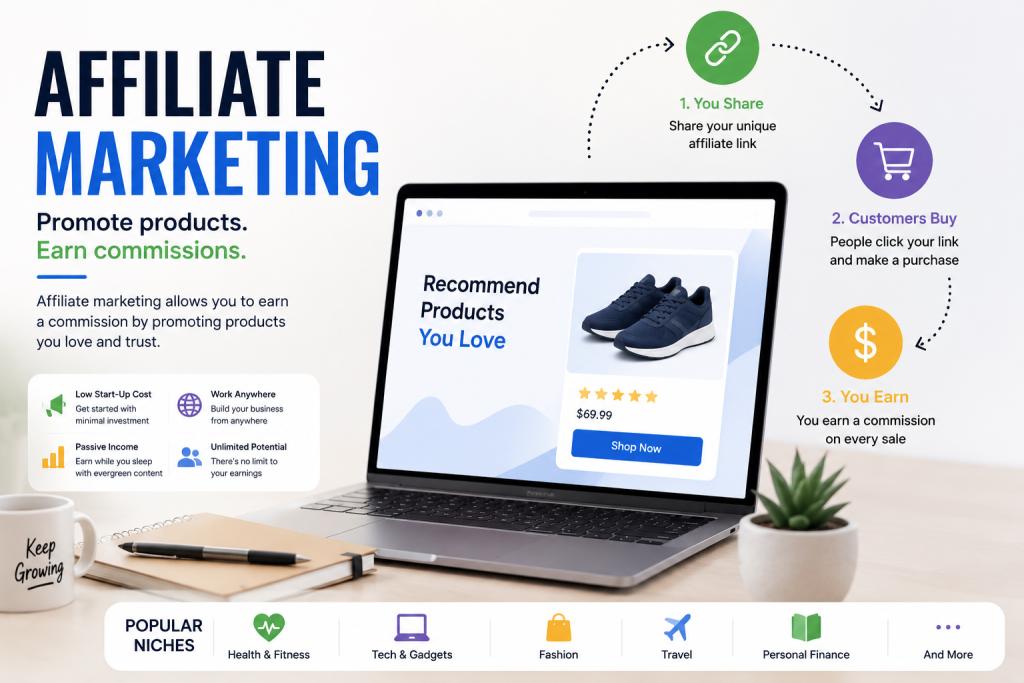
– $800 from affiliate or partner revenue

– $500 from a small SaaS tool or template bundle

None of these numbers require virality. They require consistency and a system.

Step 1: Pick One Skill You Can Monetize Three Ways

Don’t start with “what niche is hot.” Start with what you can already do — writing, design, code, teaching, editing, coaching — and ask how it can be sold as a **service**, a **product**, and a **system**.

Example: If you’re a developer, that’s:

**Service** — freelance builds for clients

**Product** — a boilerplate, template, or plugin

**System** — a SaaS tool solving one specific problem

This “three-layer” approach means you’re never dependent on a single income source, and each layer feeds the others — service clients become product buyers, product buyers become SaaS users.

Step 2: Build a Minimum Viable Offer, Not a Minimum Viable Product

The MVP obsession in tech culture gets misapplied to solo businesses. You don’t need a product first — you need an **offer** first: a clear promise, a price, and a way to pay you.

A minimum viable offer looks like:

1. A one-paragraph description of the transformation you provide

2. A price (even if it’s a placeholder)

3. A payment link (Stripe, Paystack, Gumroad, or Selar for African markets)

4. One channel to tell people about it

You can build this in a weekend. Most people spend months perfecting a product nobody has said “yes” to yet.

Step 3: Choose Your Revenue Model Stack

Here’s a realistic stack for 2026, ranked by speed to first dollar:

| Model | Speed to First Sale | Ceiling | Effort to Maintain |

|—|—|—|—|

| Freelance/services | Fast (days) | Medium | High (trades time) |

| Digital products (templates, ebooks) | Medium (weeks) | Medium-High | Low after launch |

| Membership/subscription | Slow (months) | High | Medium |

| SaaS/micro-tools | Slow (months) | Very High | Medium-High |

| Affiliate/partnerships | Medium | Low-Medium | Low |

The smart sequence: start with services or a single digital product to generate cash flow, then reinvest that revenue and time into a subscription or SaaS product that compounds.

Step 4: Price for Where You’re Selling

Pricing is where most solo builders leave money on the table. Two mistakes dominate:

**Underpricing** because you’re new — this signals low value and attracts the worst customers.

**Ignoring purchasing power differences** — a $49 template bundle is a different proposition in Lagos than in London. If you’re targeting African SMEs, price in local currency with a clear value anchor (e.g., “less than what one designer charges for one logo, you get 120 templates”).

A workable rule: price your product at the cost of the problem it solves, not the cost of your time to make it.

Step 5: Build One Distribution Channel Deeply Before Adding a Second

Spreading thin across five platforms with no traction is the single biggest reason digital businesses stall. Pick one:

**Content + SEO** — best long-term compounding channel, slowest start

**Short-form video** — fastest audience growth, requires consistency

**Cold outreach/DMs** — fastest first sale, doesn’t scale alone

**Communities you’re already in** — underrated, high trust, low reach

Get one channel producing predictable leads before touching a second. A channel at 20% effort produces close to 0% results; the same channel at 100% effort for 90 days often produces your first real revenue.

Step 6: Automate the Boring 80%

By the time you’re pushing toward $5,000/month, manual work becomes the ceiling. This is where automation pays for itself:

– Payment and delivery (Stripe/Paystack webhooks triggering automatic access)

– Email sequences for onboarding and upsells

– Simple AI-assisted content or support workflows

– Analytics dashboards so you know what’s actually working, not what feels like it’s working

You don’t need custom software here — most of this can run on tools you already have access to, wired together with a few hours of setup.

Step 7: Track One Number Weekly

Revenue is a lagging indicator. Track the **leading** number that predicts it — visitors who see your offer, conversations started, demos booked, whatever sits closest to the sale. If that number moves up consistently, revenue follows within weeks.

A Realistic 90-Day Path to $5,000/Month

**Days 1–30:** Launch one offer, one payment link, one channel. Goal: first $500.

**Days 31–60:** Double down on what worked, add a second product or service tier. Goal: $2,000/month run rate.

**Days 61–90:** Introduce a recurring element (membership, retainer, or subscription tool). Goal: $5,000/month run rate, with at least 30% from recurring revenue.

The Real Takeaway

There’s no single tactic that gets you to $5,000/month. It’s the compounding effect of one skill, sold three ways, distributed through one deep channel, with recurring revenue layered in as early as possible. Start smaller than you think you need to, get to your first sale fast, and let the system — not the hustle — do the heavy lifting.